)
Over the years, the construction industry has used various—more or less ideal—solutions for suspending drainage pipes within sewer and plumbing installations.
It has been difficult to find a solution that both ensures load-bearing capacity and eliminates thermal bridges, along with the resulting moisture and condensation issues in adjacent structures, without at the same time being time-consuming, awkward to install, or harmful to the working environment.
Fortunately, more and more contractors are beginning to address these challenges.
This is due to:
– the costly damage caused throughout the years by insufficient suspension, which has led to corroded and “suddenly hanging loose” building components and subsequent expensive renovations.
– the increasingly soft ground conditions used for new construction, as “the good plots” have already been developed.
– the growing shortage of raw materials such as gravel and stone, resulting in more buildings being constructed on point foundations—meaning installations must be suspended.
Therefore, pipe suspension is more important than ever to consider when starting new projects.
There are especially five key factors to pay attention to:
1. Thermal conduction
Until now, the best solutions the construction industry has developed have been made from stainless steel. However, this results in a solution that is difficult to work with in practice, especially when maintaining proper distance to reinforcement. Additionally, stainless steel creates a significant thermal bridge through the insulation layer—something that should be avoided. All of this can be resolved by using glass-reinforced nylon.
2. Elasticity and corrosion
It is important that suspension systems are designed to handle both compression and tension. For many years, far too many pipe hangers have been made of perforated steel tape or other galvanized steel solutions. These cannot withstand buoyant forces and will corrode over time. This does not occur with systems made from nylon, which can handle both compression and tension and are resistant to corrosion.
3. The working environment is a critical factor
Installation should be easy and ergonomic, without poor working positions. With current stainless-steel solutions, this is often difficult, especially when working in cold or muddy conditions—stainless steel is simply not a “good partner.”
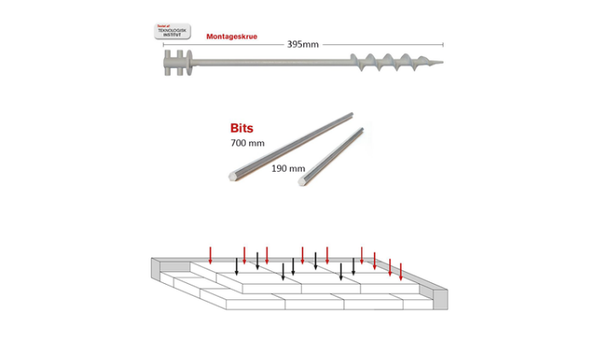
The choice of material and the installation method makes a significant difference. Lightweight materials like nylon make transport and handling on the construction site far easier compared to stainless steel hangers.
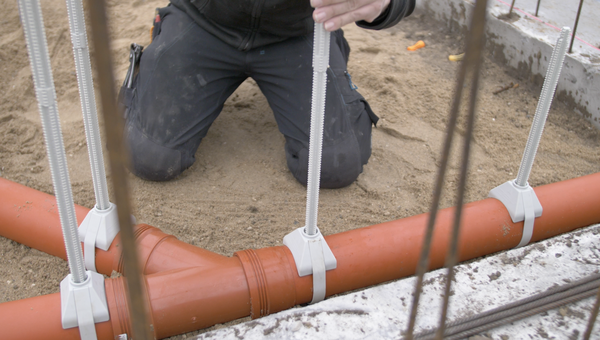
In addition, the installation method determines whether the installer must work in awkward positions to screw a suspension into place, or whether they can simply click the hanger and support bar together once everything is positioned correctly.
Another important point is the ability to install the suspension system AFTER the pipework is laid. Many current systems must be installed before the pipes are placed, causing unnecessary complications when leveling the pipes.
4. Economy — a natural result of good ergonomics
Lightweight hangers that require no tools during installation can be mounted up to five times faster than systems that do require tools. In practice, this means an installer can mount 20 per hour instead of five—something that greatly impacts the bottom line.
Furthermore, stainless acid-resistant steel hangers are very expensive, especially considering they are used to support lightweight plastic pipes—it simply doesn’t match.
5. Sustainability — a necessary priority for future construction solutions
With limited resources and environmental strain, as many products as possible must be recyclable.
Production must also be as environmentally friendly as possible. Nylon requires significantly less energy to produce compared to stainless steel, and nylon products can typically be produced closer to where they will be used—unlike stainless steel, which requires larger factories (usually abroad). This also reduces transportation needs—and therefore environmental impact.
The suspension solution from Dansk Byggekomponent is a world first, and the only system that addresses all the above issues.
The hangers are Danish-designed specifically for this purpose, ensuring that all future challenges have been carefully considered.
Danish production guarantees the highest quality and full control over every step of the manufacturing process.
You can read more about our products here, and we are happy to visit you to discuss how we can help ensure strong, future-proof, and sustainable solutions for the construction and civil engineering industry.
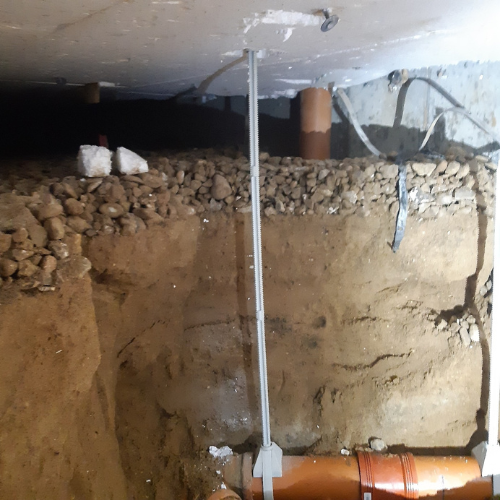
Below is an image from a customer.
It shows the existing ground slab / single-layer insulation “hanging” 30 cm above the soil/stone layer because the old support straps have broken. They had to dig in and install our new suspension system onto the sewer pipes.
The image highlights the importance of doing it correctly from the start, renovation becomes very expensive.
Note that If the insulation had been installed the modern way with several layers stacked on top of each other, the insulation would have ended up lying down on the ground.